§ October 30, 2026 · 6 min read
If You Disappeared for a Week, What Would Actually Happen to Your Business? (Introducing the New Edition of Productive Vacations)
- #owner dependency
- #operations
- #delegation
- #business growth
- #exit planning
- #book announcement
An owner sits down for what is supposed to be a real vacation. The phone stays within reach. A team member needs approval, a customer has a question, and a routine decision waits for the owner’s reply. The owner may be away from the office, but the business is still routing its work back to them.
For some small business owners, that pattern has become so familiar that taking time away feels risky. But is the business truly unable to function without you, or has it simply learned to ask you about everything?
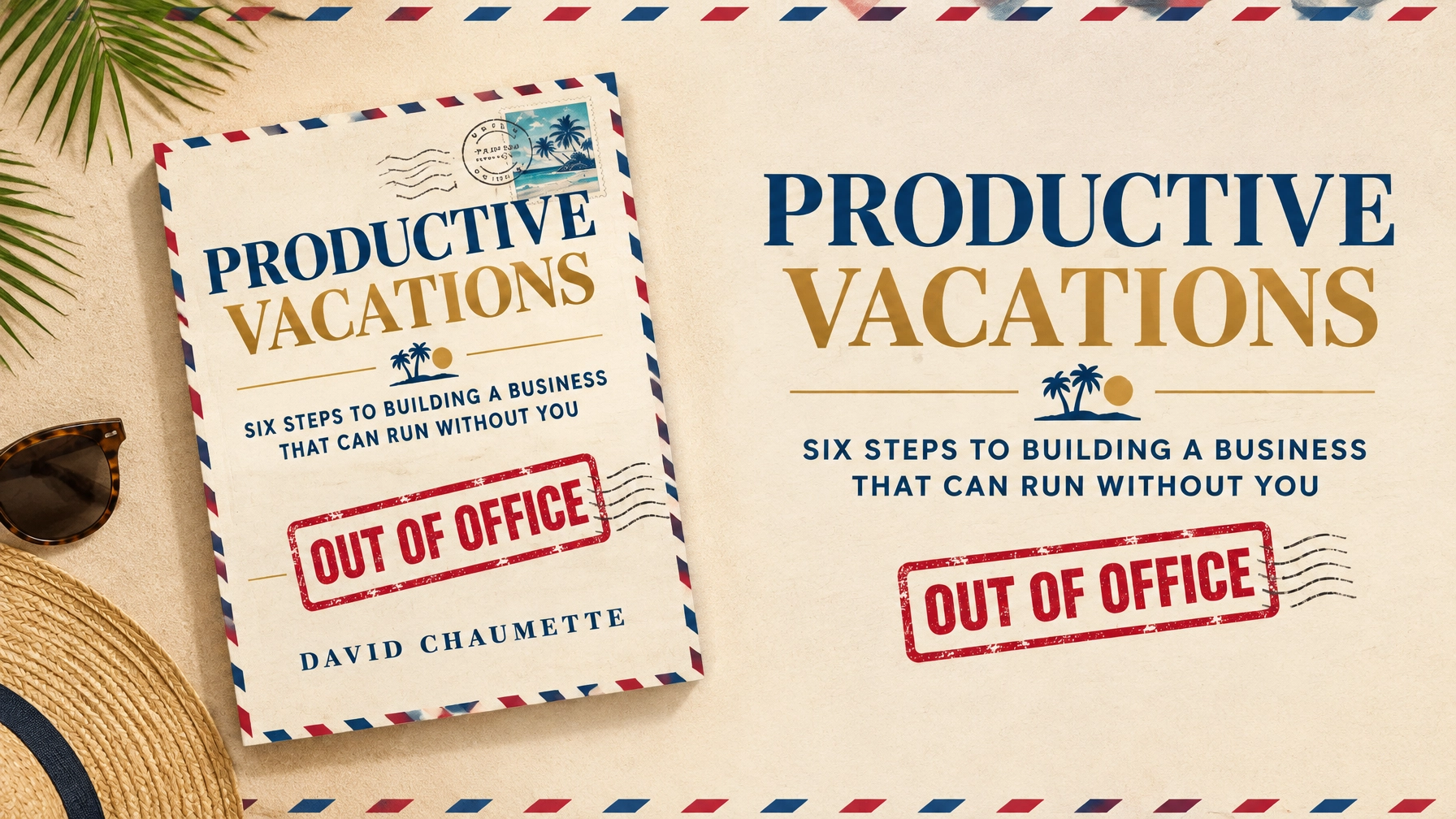
That question is at the heart of the newly published second edition of David Chaumette’s Productive Vacations: Building a Business Without You Every Day, available now on Amazon.
“If you disappeared for a week, what would actually happen to your business? Not what you assume would happen. What would actually happen.”
Treat owner dependency as a question to test, not a fact to assume
Many owners answer that question with a feeling: It would fall apart. Then they treat the feeling as evidence. The book makes a more precise distinction: a handful of specific decisions may genuinely require the owner. Everything else may be a habit of being asked.
That distinction matters. If tasks, updates, and routine questions all reach you, it can be hard to tell which decisions truly need your judgment. And if you can’t tell, it’s difficult to know what to delegate, where to improve a process, or who should be trusted to act.
Productive Vacations offers a way to find out on purpose and on your own schedule. Before an illness or family emergency forces the question. A planned absence becomes a controlled test: step away, see what breaks, fix it, and step away again.
That is not about abandoning responsibility. It is about using what you learn to strengthen efficient business operations and reduce bottlenecks.
The Hero-to-Architect shift begins with better questions
A founder often becomes the person who solves everything. That can be an effective way to get a business moving, but as the company grows, being the default answer to every question can limit the team and the owner alike.
The Hero-to-Architect arc is a shift from personally rescuing each process to designing the conditions that let good work happen without constant intervention. Instead of asking, “How do I handle this faster?” an owner can ask:
- What actually needs my decision?
- Who should have authority over it?
- What information or boundary would help them act?
- How will I know whether the process is working?
This is where business process improvement becomes more than documenting tasks. A team may know what to do and still lack permission to decide. The second edition goes beyond handing off tasks to address that harder problem: giving people authority and accepting that a reasonable decision may not be the one the owner would have made.

A six-step path from assumption to continuity
The book lays out six steps for testing owner dependency and building a more resilient operation:
- Test the assumption. Examine whether the business really cannot function without you, rather than treating that belief as settled fact.
- Inventory what reaches you. Separate tasks and information from genuine decisions that require your judgment.
- Map decision authority. Identify who should hold authority for each decision, and what is stopping them today.
- Set up office hours. Create a way for genuine exceptions to reach you while routine questions do not.
- Use time away to expose bottlenecks. Pay attention to what breaks, including bottlenecks that turn out to be you.
- Build continuity. Reduce the extent to which the business depends on any one person.
The steps are practical, but the underlying work is strategic. They connect operating decisions to small business growth: as the company develops, its ability to make decisions and maintain continuity needs to develop too.
The second edition focuses on authority, not just task handoffs
The second edition has been substantially rewritten. Its central challenge is familiar to owners who have tried to delegate: assigning a task does not necessarily give someone the authority to complete it independently.
If an employee must ask permission at every decision point, the owner remains the bottleneck, even if someone else performs the work. And if the owner expects every decision to match their own preferences, delegation may exist in name only.
The book’s approach asks owners to distinguish between a decision that must be theirs and a reasonable decision that someone else can make. That shift can support more efficient operations while clarifying responsibility across the team.
To help readers work through the process, the book includes four practical worksheets:
- Decision Inventory
- Authority Map
- Return Review
- Continuity Audit
Fillable PDF copies of all four worksheets are available at chaumettesolutions.net/vacations.

A planned absence can reveal what routine work hides
When an owner is available to answer every question, the business may appear to be running smoothly. But that can conceal a dependency: decisions accumulate, people wait for direction, and small interruptions keep the owner tied to daily work.
A planned absence makes those patterns easier to see. Which questions can be handled with clear authority? Which issues are true exceptions? Where do people lack the information or permission they need? What becomes a bottleneck when the owner is not immediately available?
The purpose is not to engineer a perfect week away on the first attempt. It is to learn, make adjustments, and test again. A gradual approach lets an owner identify weak points before an urgent situation makes them impossible to ignore.

Why this work matters for growth and a future exit
A business that depends heavily on its owner can make growth harder to sustain. It can also make succession planning for a small business more challenging: continuity depends not only on documented tasks, but on whether decisions can be made when the owner is unavailable.
That is why this work can be relevant well before a sale or transition is imminent. It helps owners examine the way work and authority are organized today. For a deeper look at how operating independence connects to growth, explore three ways to get your business to run without you. If an eventual sale is part of your plans, see seven mistakes to avoid with your exit strategy.
A business exit strategy is not only about a future transaction. It also involves building a company that can function with less reliance on one person. The work of creating that capacity can start with the decisions reaching you this week.
Start with an hour, then learn from what happens
You don’t need to begin with a week away. Start by noticing what reaches you, separating routine requests from genuine decisions, and clarifying who has authority to act. Then make time away a gradual, intentional test.
As the book puts it: “You don’t need to disappear for three weeks to prove anything. Start with an hour. Then an afternoon. Eventually, leaving stops feeling like a test.”
Read David Chaumette’s new second edition of Productive Vacations: Building a Business Without You Every Day on Amazon. The fillable PDF versions of the book’s four worksheets are available at chaumettesolutions.net/vacations.
For help applying these ideas to your company’s operations, growth, or transition planning, explore Chaumette Solutions and start a conversation with David.